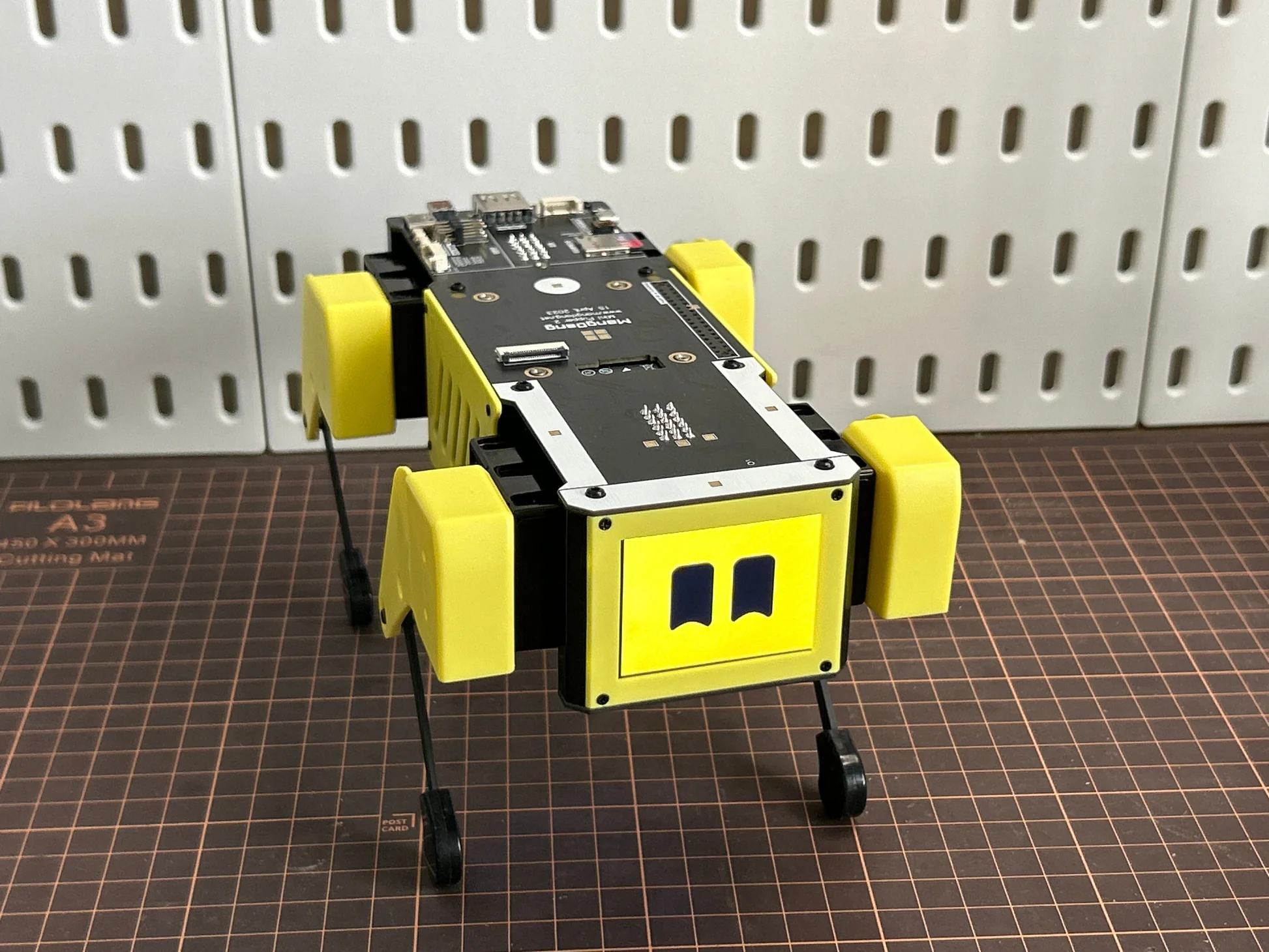
Mini Pupper 2 Robot
2026 Winter Teaching team:
Welcome to the course page for class on legged robots using the Mini Pupper 2 platform! This course offers a hands-on introduction to AI-powered robotics. Unlike most introductory robotics courses, students will learn essential robotics concepts by constructing a Mini Pupper 2 quadruped robot and training it to perform real-world tasks such as navigation and command following. The course covers a broad range of topics critical to robot learning, including motor control, forward and inverse kinematics, system identification, simulation, and reinforcement learning. Through intensive labs, students will construct and program the Mini Pupper 2 robot. In the final days, students will undertake a project demonstrating their robot's capabilities.
Time: December 21, 2025 – January 31, 2026 (Online + Onsite)
Lecture Location: Tonji University Department of Architecture Building , in-person attendance required for onsite phase
Instructor Office Hours:
TA Office Hours Location: Tonji University Department of Architecture Building
TA Office Hours:
Prerequisites:
Grading: Students will work in assigned groups for all labs and the final project. All group members will receive the same score for each lab. Some labs may include individual written homework, which will be graded separately.
Attendance: Attendance is mandatory for all classes and counts for 3% of your grade. Missing 0-1 classes gives you full credit, missing 2 classes gives you 50%, and missing more than 2 gives you 0%. Students are expected to attend all classes in person. If you are unable to attend a class, please inform the teaching team in advance.
Lab Policies:
Labs: Labs are due before class the beginning of the day before the next lab unless otherwise noted. Each team has a total of 7 late days to use across all labs. It is pertinent for the deliverables to be prompt as it will help the progress of the full project
Final project: No extensions are allowed for the final project proposal, progress report, or final demo video/presentation.
Enrollment: ~24 students; 6 groups of 4-5 students
Mini Pupper 2 Kit:
Computing Hardware:
One of these recomended sensor(s):
Optional Sensor:
| Session | Date/Time | Lecture | Resources |
|---|---|---|---|
| SFK Online 1 | 2025/12/21 Sun 13:30-15:30 BJ |
Introduction & Workshop | |
| SFK Online 2 | 2025/12/24 Wed 19:00-21:00 BJ |
Project Proposal & Discussion | |
| Javier Online Session 1 | 2025/12/27 Sat 10-12 am BJ (12/26 Fri 6-8 pm PST) |
Command Line Fundamentals | Slides: Command Line Fundamentals Practical Guide: Command Line Homework Homework Recorded Lecture |
| SFK Online 3 | 2026/12/28 Sun 13:30-15:30 BJ |
Research Course | |
| Javier Online Session 2 | 2026/1/1 Thurs 10-12 am BJ (12/31 Wed 6-8 pm PST) |
ROS2 URDF Visualization and ROS2 Fundamentals | Lecture Jupyter Notebook Recorded Lecture |
| Javier Online Session 3 | 2026/1/3 Sat 10-12 am BJ (1/2 Fri 6-8 pm PST) |
ROS2 Fundamentals (Nodes and Topics) | Class Activity and Homework Recorded Lecture |
| SFK Online 4 | 2026/1/7 Wed 19:00-21:00 BJ |
Design Concepts & Methods | |
| Javier Online Session 4 | 2026/1/11 Sun 10-12 am BJ (1/10 Sat 6-8 pm PST) |
Computer Vision in Robotics | Lecture Slides Homework |
| SFK Online 5 | 2026/1/14 Wed 19:00-21:00 BJ |
Project Proposal Presentation | |
| Javier Online Session 5 | 2026/1/18 Sun 10-12 am BJ (1/17 Sat 6-8 pm PST) |
Project Planning & Tool Deep-Dive | What sensors/ROS2 packages will you need to build your project? |
| Day/Date | Morning (10:00-12:00) | Afternoon (14:00-17:00) | Evening |
|---|---|---|---|
| Day 1 Thurs 1/22 |
Arrival (12:00-14:00) | Opening & Ice-Breaking Activities (19:00-20:00) Rest |
|
| Day 2 Fri 1/23 |
Morning Call + Breakfast + Course Set-up (8:00-9:30) Hardware Familiarization (10:00-12:00) |
Hardware Familiarization (14:00-16:00) SFK Design Course: Define-Critique (16:00-17:00) SFK Studio (17:00-19:00) |
Self-study session (20:00-22:00) |
| Day 3 Sat 1/24 |
Iterative Building (10:00-12:00) | Iterative Building (14:00-16:00) SFK Design Course: Design-Lecture (16:00-17:00) SFK Studio (17:00-19:00) |
Self-study session (20:00-22:00) |
| Day 4 Sun 1/25 |
SFK Design Course: Design-Critique (10:00-12:00) | SFK Studio (14:00-16:00) SFK Studio Professor Yu (16:00-17:00) SFK Studio (17:00-19:00) |
Self-study session (20:00-22:00) |
| Day 5 Mon 1/26 |
Iterative Building (10:00-12:00) | Lunch + Break (12:00-14:00) Iterative Building (14:00-16:00) SFK Design Course: Develop-Tutorial (16:00-17:00) SFK Studio (17:00-19:00) |
Dinner (19:00-20:00) |
| Day 6 Tues 1/27 |
Iterative Building (10:00-12:00) | Iterative Building (14:00-16:00) SFK Design Course: Develop-Critique (16:00-17:00) SFK Studio (17:00-19:00) |
Self-study session (20:00-22:00) |
| Day 7 Wed 1/28 |
Iterative Building (10:00-12:00) | Iterative Building (14:00-16:00) SFK Design Course: Outcome-Tutorial (16:00-17:00) SFK Studio (17:00-19:00) |
Self-study session (20:00-22:00) |
| Day 8 Thurs 1/29 |
Optional Lecture: Language Models for Robotics (10:00-12:00) | Polish & Integration (14:00-16:00) SFK Studio (17:00-19:00) |
— |
| Day 9 Fri 1/30 |
Final Exhibition Preparation | Day Off for Instructor (Javier) | |
| Day 10 Sat 1/31 |
Final Exhibition (Research Talk at the beginning of the day?) | Return Home | |
Total Contact Hours: 10 hours online (Javier) + 10 hours online (SFK) + 20 hours onsite instruction = 30 hours
All software is open-source and will be installed during the online sessions:
mini_pupper_ros, mini_pupper_description)Program Details:
References: References Page